Showing posts with label safety. Show all posts

Monday, October 8, 2012

Airplane Travel With Lap Babies - Who Cares?


I know that parents care deeply for their children.  But air travel can be expensive, and when calculating costs of purchasing a seat for their babies versus the risks of holding their babies in their laps, many many many parents do choose to take the chance that their flight will be an uneventful flight.  After all, it's LEGAL, isn't it?

Yes, it's legal, but it's not recommended.  Not by the airlines themselves.  Not even by the airlines' regulatory agency.

There are two agencies involved in this issue.  One is the FAA, the Federal Aviation Authority.  The other is the NTSB, the National Transportation Safety Board.

So, in answer to the title of this post, who cares about lap babies? The NTSB does, and they don't want the practice to be permitted. The FAA? Well, they only care when you care.

Let's compare the priorities of the two agencies: 
  • The FAA regulates air transportation.  That includes flight routes, air traffic control, licensing pilots, setting equipment inspection standards and quality controls.  (The FAA also regulates the growing field of commercial space travel -- when Richard Branson is developing Virgin Atlantic space travel, or SpaceX launches a rocket, they have to work with the FAA.)   Sounds to me like they have a very "top down" mission, i.e., air transportation from the perspective of geography, equipment, pilots, mechanics.
  • The NTSB's, on the other hand, investigates crashes -- auto, train, bus, air.  Their priorities are gathering data on damage and injuries, analyzing it, and applying that knowledge to the protection and safety of travelers.  Their mission seems more "from the ground up" than "from the top down." Passengers figure very prominently.
In short:  FAA, macro: systems, equipment, regulations, focused on the whole, keeping it functioning as a system.  NTSB, micro: looking out for the individual, keeping each individual safe.

The FAA recommends that babies under 2 years old have their own seats, but they don't REQUIRE it.  This fine distinction between recommending and requiring is the thin sliver of hope parents cling to when choosing to fly with lap babies.
  • (The FAA does have definite requirements about the EQUIPMENT involved when babies travel in airplanes, as any parent who's every had to fight for their right to install their child's car seat in one of their planes. Perhaps it is the car seat's potential to interfere with equipment and procedures that concerns them more.  Another possible example of "the whole" versus "the individual.")
The NTSB strongly recommends that parents purchase individual seats for their children, and practically implores the FAA to make it a requirement.  To make it illegal for babies to travel in their parents' laps in an airplane, just like is in a car.  As NTSB Accident Investigator Nora Marsh says in this video:  "The laws of physics don't change when you get on an airplane, so why wouldn't you want your child to have the same level of protection as they had in the car?"

Thursday, December 8, 2011

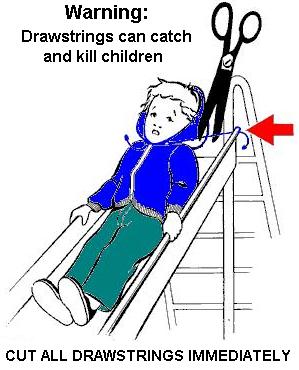
NO. DRAWSTRINGS. ON. HOME. MADE. PONCHOS!!!!

When I developed the Car Seat Poncho in 2005 for my son, you had to look pretty hard to find information about the risks of puffy coats under car seat straps.  I only learned about it by reading the fine print in my car seat's manual, and the only other mention of it was in an About.com article by Heather Corley.

Fast forward, six years later, and the compression risks of a puffy coat in a car seat are ALL OVER.  TV news, blogs, books -- you name it.  I am so glad that more people know about it and that so many parents want to do whatever they have to do to keep their precious children safe.  My product is one option.  Some moms are crafty, and they want to make their own.  I totally get that.  I did the same thing six years ago.

Five days ago, a mom on the August 2010 Cafemom birth board posted about the no-sew poncho she made.  There are two layers, sewn together at the neck, which then serves as a drawstring.  It's adorable.  It might be warm, but it's not safe.

BECAUSE...

Drawstrings on children's clothing are strangulation hazards!

From BabyCenter: "CPSC issues new drawstring safety rule for children's clothing: The final rule designates children’s upper outerwear in sizes 2T through 12 with neck or hood drawstrings as substantial product hazards.."


From the Consumer Products Safety Commission: "Drawstrings at Neck and Waist Present Strangulation Hazard and Other Dangers"


From the Child Injury Law blog:  "CPSC Deems Drawstrings a "Substantial Product Hazard," Strengthening Rules on Their Production and Distribution"

This was one of the first things I blogged about.  Think about how much is going on when you are trying to leave the house with two little kids.  Consider all the movement and possible entanglements: getting out of the house, slinging diaper bags, seat belts, buckling, unbuckling, etc. The consequences could be disastrous.


This nice mom wanted to do a sweet thing for her children (she made one for each child), but traded one hazard for another.  The drawstrings are right around her children's necks, and it was even suggested one be tied around the back of the neck(!).  If you are considering using her no-sew method yourself, or if you see her online, please tell her:
 
NO. DRAWSTRINGS. ON. CHILDREN'S. CLOTHING.  EVER

PLEASE!


Monday, November 21, 2011

Top 5 Responses to "When I Was A Kid, There Were No Car Seats."

When you hear someone chuckle the above, remain calm.  Then take a deep breath and say, "Well, back then..."

5.  "... THERE WERE FEWER CARS ON THE ROAD."  In 1960 there were 74 million cars on the roads.  Not every household had a car.  And almost none had more than one.  And many women did not drive (well, many did not have jobs outside the home anyway, so what was the point?).  In 2004 there were 240 million motor vehicles on American roads.  By now, it might be just under 280 million.  And most women drive.  More cars means more traffic, more red lights being run, and significantly, more potentially distracted drivers.  The more cars there on the road, the more risk to each passenger.  We're only as strong as the weakest link.

4.  "... MOST CARS WERE ABOUT THE SAME SIZE."  We're talking passenger cars, that regular people could buy.  Minivans and SUVs hadn't been invented yet.  And, for those of you who remember those big boat-sized cars, there had huge crumple zones in front and back (until the Volkswagon Beetle and other compact cars came out).  Now you have Escalades and Suburbans on the same roads as Corollas and Fiestas.  With such dramatic differences in weight and size, the potential for serious injury is much greater.

3.  "... CARS DIDN'T TRAVEL AS FAST."  At least not as easily.  Today's cars are engineered more efficiently and designed so aerodynamically that you can hit 75 mph without hearing a rattle or a hum.  Can't say that about a Dodge Dart (from the late 70s).  So, local traffic running these days at 30 mph? Very rarely.  If you're not going at least 40 mph you're slowing everybody down.

2.  "... KIDS DID NOT SPEND NEARLY AS MUCH TIME IN THE CAR."  The average American child spends more time in a vehicle now than ever -- about an hour a day.  For younger children, the figure is likely higher, as they accompany their older siblings to and from school and activities, or their parents on everyday errands.  In "their" day, neighborhoods had town centers, where you could walk to get a carton of milk.  Now, most suburban families have to get into the car to do the simplest errands: pick up the dry cleaning, get the groceries, fill a prescription, etc.  I read a great quote on this at a popular parenting board: "Riding in a car is the most dangerous thing my kids do.  And they do it every day."

And the #1 reponse to "When I was a kid, we didn't have car seats, and I turned out ok" is:

1.  "WE'LL NEVER HEAR FROM THE KIDS WHO DIDN'T."  Motor vehicle crashes are the #1 cause of fatal injury for children.  If we have the tools and the knowledge to protect our children from injury or death, shouldn't we use them?

We all have anecdotes about how our childhoods were simpler. Some may argue that the old days were better, and in many ways, they were. But there is no question that advancements in technology and communications have also enhanced (and prolonged) our lives. So resist the temptation to disregard today’s safety advice. Make sure your kids stay safe whenever they are in a car, so that in years to come (when their world is unrecognizable to us!), they, too, will be talking about "back in the day."

To read my 2009 post on the topic (with more sources and statistics links), click here.

Monday, June 20, 2011

Kids in Hot Cars, Part 2

Do tinted windows contribute to hyperthermia deaths for children left in closed vehicles?

According to David Bell, the inventor of the VizKid, they certainly don’t help. Tinted windows (now standard in the second and third rows of minivans and SUVs) are great for the comfort and privacy of backseat passengers, but they also make those passengers invisible. So if the driver or other adult leaves the car in a hurried or distracted state, he or she could not see the child from outside the car. Nor could anyone passing by -- people who could literally have been a life line for that child.

Bell’s invention, the VizKid, is a visual cue to drivers and passers-by that a child is in the back seat. After seating and buckling the child, the driver lifts the VizKid upright and buckles it into the front row passenger seat. Ideally, when the driver leaves the car and takes the child, the VizKid goes down again. If the driver is distracted when s/he exits the car, but sees the VizKid before walking away, tragedy avoided. If the driver does leave, someone else could see the VizKid in the front seat and rescue the child before it is too late.

Check out the VizKid and Visible Kids LLC here.

Monday, January 10, 2011

Great Review on About.com

Great grade from About.com
 The Car Seat Poncho got a/nother great review, this time on About.com's "Baby's First Year" blog:
"When I first glanced at this product, I'll be honest and say I wasn't too sure about it. I am a New Englander, and the winters up here get beyond frigid.
Would the Car Seat Poncho really keep my baby or toddler warm? Closer inspection reveals a solid, "Yes!"
The reason being, this poncho is made out of not just one layer of fleece, but two layers of 400-weight fleece. The weight of the blanketed poncho traps warm air next to your child while you go out to the carseat.
The other features of this product that I find appealing over some of the other winter car seat accessories are:
  1. It works with both infant car seat carriers AND any 5-point harness. So if you are using a convertible car seat, this product will work for you.
  2. It prevents any layers of material from coming between your baby and the harness straps. The straps remain as close to your baby as possible at all times, unlike popular winter gear like the Bundle Me.
  3. It also can be used as warm weather wear. You get to your destination, and your child has the freedom to walk around and still keep warm."
Thanks to blogger Jennifer White, of About.com.  FYI: Unlike many other "product review" blogs, there was no "freebie" product given in exchange for a review.  Ms. White chose the Car Seat Poncho to review based on her own research and suggestions from her readers -- bona fide journalism!

Was there anything she left out of her great review?  Leave your two cents in the comment area for the article:  http://baby.about.com/b/2011/01/03/the-car-seat-poncho.htm#commentform

Want to read some more love?  Here are more Car Seat Poncho reviews.